DIY electronics synth
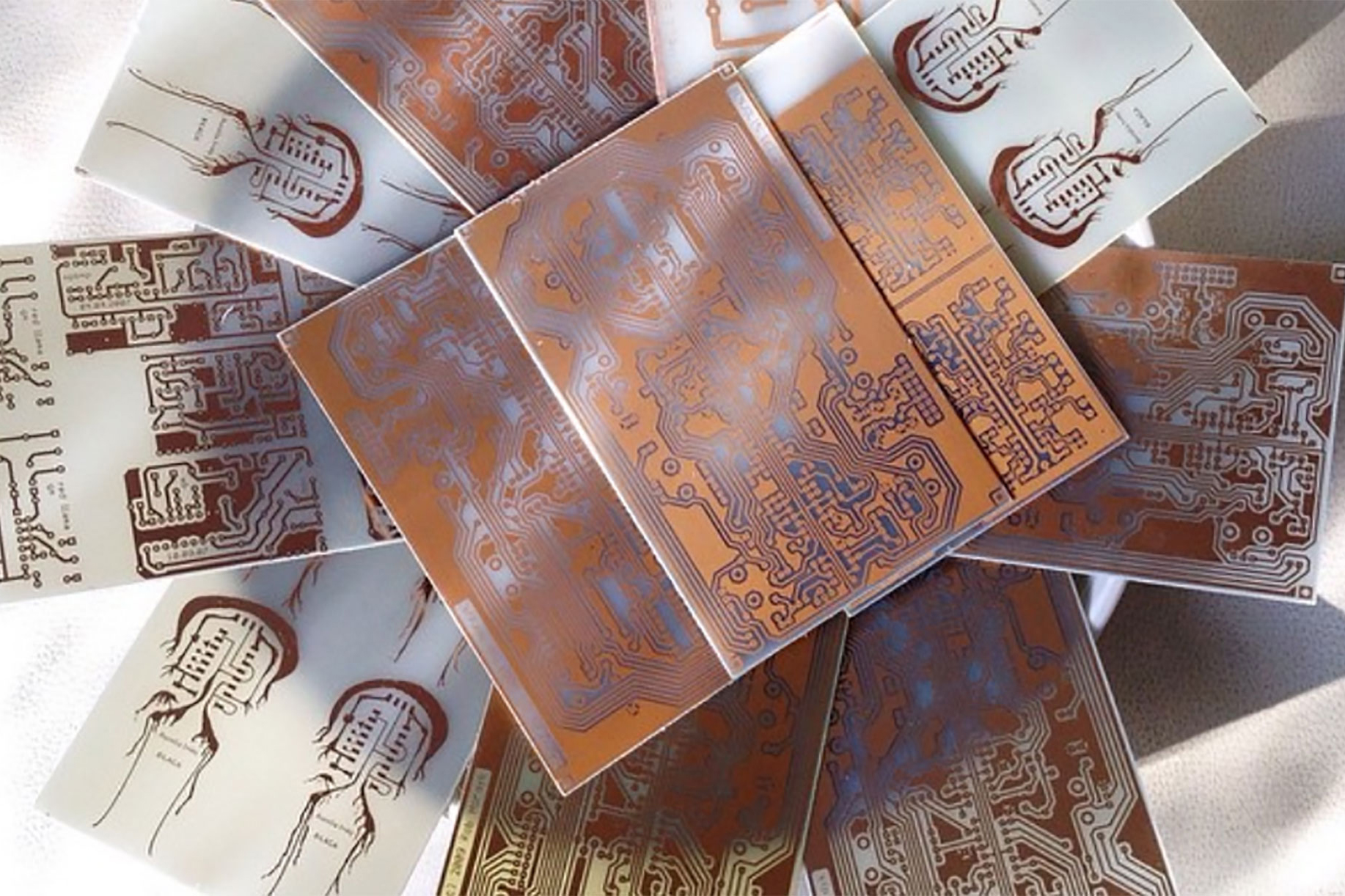
The Benjolin isn’t particularly difficult to build for such a wonderfully unpredictable noise synth, but it does require some experience with DIY electronics. The PCB etching design was kindly provided by Peter Edwards of Casper Electronics. Following the latest update to his website, the schematics, PCB design, parts layout, and bill of materials were moved to the Electro-Music Forum. Peter is officially approved to share this beautiful piece by the Benjolin’s creator, Rob Hordijk. We etched the board at Ljudmila Art and Science Lab, and the process turned out to be much messier than the instructions for etching PCBs in-house would suggest. Macumbista also produces batches of amazing single and double Benjolins each year, which is perfect for those who don’t want to spend weeks on this project.
The recording of jamming with Dual Benjolin gives some impression of the versatility and unpredictability of the machine. In the first minute, I used a wet Eventide Time, and the rest is just raw Dual Benjolin with modular extensions. (I made the mistake of plugging the MixPre-II recorder into a different phase, which produced a 4kHz+ hiss.) The “rangler” function produces long “pseudorandom” loops that create short stepped patterns of variable length and speed, sometimes taking up to 40 seconds to come around. Rob Hordijk explains it is “a CMOS shift register clocked by one oscillator and receiving its data input from the other oscillator”. The function is even more interesting because the previous position affects any position. I can never simply go back without affecting something differently. There is no delete button, just the here-and-now.
Mental note: potentiometers on Benjolin are highly sensitive, so it makes sense to use huge knobs.
There were a few mind-boggling twists in the making, like getting a “not too expensive” Yamaha YM2164 chip. Getting an original would cost around 25€, so getting a clone at Small Bear was much more tempting, and it works just fine. Another thing that took me some time to figure out was the power supply… this was my first instrument that required a +/-15V power supply, which is generally used for modular synths. I decided to power two Benjolins and Wolfgang Spahn’s [dernulleffekt] PB808 Kick Drum paper-pcb with the same power supply.
I needed some time to figure out the best casing for the instrument. I do not really like crude aesthetics and square-minded assembly of electronics in ugly boxes. At first, it seemed there was so much more to be expressed in our interfaces. The way we put things together is not the most logical way to build them but just a cultural consensus. To change the hegemonic male-dominated culture, one must think about different interfaces… breaking a wire or a knob in the process… I’m sharing plans for a new casing for a Double Benjolin with modular extensions inspired by Hallik Engineering Ambika case design: front panel (Combond aluminium plates or plexiglass), back panel (Combond aluminium plates or plexiglass), side panel (wood).
Cost of build: (Benjolin + knobs + power supply + casing): approx. 150-200€
Build duration:
- 1 to 2 days for ordering (BOM and casing materials) + delivery time
- 1 to 2 days for PCB etching
- 2 to 3 days for soldering (synth & power supply)
- 1 to 3 days for casing (access to a woodwork or CNC machine, access to a laser-cutter)


